In 2026, educational toys are becoming practical tools for deeper classroom learning. STEM construction kits, programmable robots, mathematics manipulatives, and role-play sets can turn abstract ideas into visible actions. Grand View Research projects continued growth in the global educational toys market through 2030, reflecting stronger demand for learning products with measurable value. The LEGO Group’s 2024 Play Well Study surveyed more than 61,000 children and adults across 36 countries. It reported that 96% of children believe play helps them learn. Play matters. Yet popularity alone does not prove effectiveness.
The key question is, how can schools use educational toys effectively? Teachers can connect each toy to a clear learning objective, not simply place it in a colorful activity corner. A robot might help pupils test sequencing and debugging. Fraction tiles can make equivalent fractions visible on a real desk. A cooperative building challenge can reveal communication skills, planning, and misconceptions. OECD learning research consistently emphasizes active participation, feedback, and problem-solving. These principles should guide toy selection and classroom use.
Schools also need reliable evaluation. Teachers can record a child’s explanations, design changes, and teamwork during a ten-minute activity. Short rubrics can show whether learning improved. Some expensive kits may create excitement without lasting understanding. That is uncomfortable, but important. A quieter, low-cost puzzle may produce stronger reasoning than a complex gadget. Accessibility, durability, cultural relevance, and safe classroom handling deserve equal attention. The best 2026 choices will support skilled teaching, not attempt to replace it.
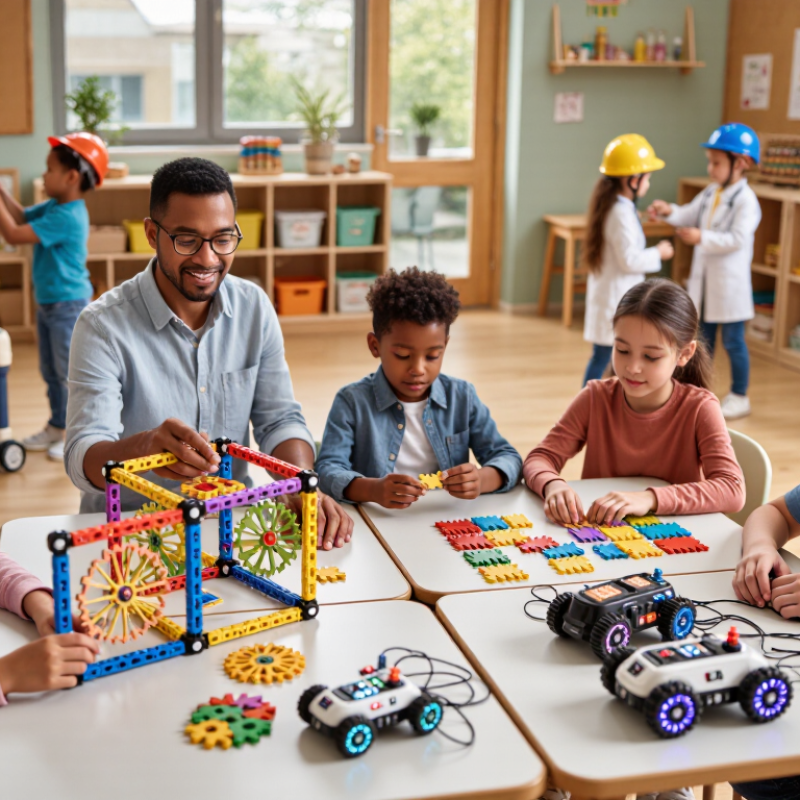
In 2026, an educational toy is more than a colorful object with a learning label. It should create purposeful, hands-on experiences with visible learning outcomes. UNICEF’s Learning Through Play guidance identifies five qualities: joy, active engagement, meaningfulness, social interaction, and iteration. A strong toy lets children test ideas, make mistakes, and try again. It might include gears, counting tiles, story cards, or simple engineering parts. The materials should support language, problem-solving, creativity, or fine-motor development.
The OECD’s PISA 2022 Creative Thinking assessment covered 64 countries and economies. About 78% of students reached the baseline level of creative thinking. Schools can respond by selecting toys with several possible solutions, not one correct answer. A teacher might ask pupils to build a bridge from ten pieces, explain their choices, and improve the structure after testing it. The activity produces evidence through speech, sketches, cooperation, and revision.
The label remains imperfect. A complex toy can overwhelm younger learners, while a very simple toy may encourage deeper thinking. The 2025 World Economic Forum Future of Jobs Report names creative thinking among the important growing skills. Therefore, schools should examine accessibility, durability, cultural relevance, and teacher guidance before purchasing. A toy should support learning, not quietly replace it.
A school-use comparison of educational toy categories, learning goals, classroom applications, and measurable outcomes
| Educational Toy Category | Typical School Age | Primary Learning Outcomes | How Schools Can Use Them | Important Design Features | Observable Assessment Indicators | Safety and Inclusion Considerations |
|---|---|---|---|---|---|---|
| Construction and Building Sets | 3–11 years | Spatial reasoning, balance, planning, fine-motor control, creativity, and early engineering thinking | Use during design challenges, mathematics centers, small-group projects, and open-ended problem-solving tasks | Multiple solutions, varied shapes and connectors, durable parts, and opportunities to test and revise designs | Learners explain design choices, build stable structures, compare measurements, and improve a prototype after testing | Use age-appropriate pieces; avoid small parts for children under three; provide large-grip components and visual instructions |
| Counting, Sorting, and Pattern Materials | 3–7 years | Counting, one-to-one correspondence, classification, sequencing, pattern recognition, and early algebraic thinking | Use in guided mathematics activities, independent stations, number games, and real-world classroom counting tasks | Clearly distinguishable attributes such as color, size, shape, and quantity; manipulable objects; increasing levels of challenge | Learners count objects accurately, explain sorting rules, extend patterns, and represent quantities in more than one way | Offer tactile, visual, and verbal directions; use high-contrast pieces; inspect regularly for damage or choking hazards |
| Puzzle and Logic Games | 4–14 years | Reasoning, working memory, persistence, sequencing, visual discrimination, and strategic thinking | Use for morning work, learning centers, enrichment, intervention, and collaborative problem-solving sessions | Clear rules, graduated difficulty, meaningful feedback, more than one strategy, and opportunities for reflection | Learners describe strategies, revise unsuccessful approaches, complete increasingly complex tasks, and justify solutions | Provide alternative response methods, allow additional time, and avoid tasks that depend solely on speed or reading ability |
| Early Coding and Robotics Kits | 5–14 years | Sequencing, algorithms, debugging, computational thinking, collaboration, and systems thinking | Use in unplugged coding lessons, STEM projects, technology classes, and cross-curricular storytelling or geography activities | Immediate feedback, screen-free options, programmable sequences, accessible controls, and tasks connected to curriculum goals | Learners create a sequence, predict results, identify errors, test changes, and explain how an algorithm solves a problem | Protect personal data, use offline modes where possible, supervise moving parts, and provide non-screen participation routes |
| Science Experiment and Discovery Kits | 6–14 years | Observation, classification, measurement, prediction, evidence-based reasoning, and scientific communication | Use for inquiry stations, demonstrations, science notebooks, environmental investigations, and project-based learning | Safe materials, repeatable investigations, controlled variables, clear instructions, and prompts for recording evidence | Learners make a prediction, conduct a fair test, record observations, identify patterns, and support conclusions with evidence | Follow classroom chemical and equipment procedures; avoid hazardous substances; provide adapted tools and multilingual labels |
| Language, Storytelling, and Dramatic-Play Materials | 3–9 years | Vocabulary, oral language, narrative structure, listening, perspective-taking, and social communication | Use in literacy centers, role-play areas, language intervention, reading response, and collaborative storytelling | Open-ended characters and props, culturally varied scenarios, picture prompts, and opportunities for children to lead the play | Learners retell events, use new vocabulary, maintain a conversational turn, describe characters, and create a coherent sequence | Include nonverbal communication options, accessible figures, and materials representing varied cultures, families, and abilities |
| Art, Music, and Creative-Making Materials | 3–14 years | Self-expression, fine-motor coordination, rhythm, creative decision-making, sensory exploration, and communication | Use for choice-based centers, integrated arts projects, emotional expression, presentations, and portfolio development | Open-ended outcomes, varied textures and tools, reusable materials, process-focused prompts, and low emphasis on copying a model | Learners select tools intentionally, describe creative choices, experiment with materials, and revise or extend their work | Use non-toxic, washable materials; provide adaptive grips, noise-reduced options, and alternatives for sensory sensitivities |
| Cooperative Board and Role-Play Games | 5–14 years | Communication, negotiation, emotional regulation, turn-taking, ethical reasoning, and collaborative decision-making | Use in social-emotional learning, citizenship lessons, conflict-resolution practice, and small-group discussion | Cooperative goals, transparent rules, manageable play time, discussion prompts, and opportunities to consider different perspectives | Learners listen to peers, follow agreed rules, explain decisions, manage disappointment, and work toward a shared objective | Avoid exclusionary themes; offer visual rules, communication supports, flexible group sizes, and alternatives to competitive scoring |
| Financial and Real-Life Simulation Sets | 7–14 years | Numeracy, budgeting, decision-making, delayed gratification, planning, and understanding everyday systems | Use for mathematics modeling, personal-finance lessons, classroom economies, and interdisciplinary project work | Authentic scenarios, adjustable difficulty, transparent calculations, reflection questions, and recognition of different household contexts | Learners calculate totals, compare choices, explain trade-offs, create a plan, and revise decisions when conditions change | Use inclusive examples; avoid assumptions about family income; provide accessible number formats and calculator-supported options |
| Sensory and Self-Regulation Tools | 3–14 years | Attention management, body awareness, emotional regulation, motor planning, and readiness to learn | Use as part of a planned regulation area, transition routine, occupational-therapy support, or individualized learning plan | Predictable use, choice, adjustable intensity, clear time limits, quiet options, and connection to self-monitoring strategies | Learners identify their state, select an appropriate tool, use it safely, and return to a learning activity with reduced disruption | Complete an individual needs assessment; supervise use; avoid treating sensory tools as punishment or as a substitute for professional support |
Start with a clear learning goal. Choose tools that make children speak, compare, build, or explain. A fashionable label proves little. The toy must support the lesson.
Letter tiles support sound recognition and word building. Story cards help children practise vocabulary and sequencing. Ask pupils to explain picture order aloud. Quiet arranging is not enough.
Counters make quantities visible. Pattern blocks support prediction and classification. Balance scales let children compare weight. Ask pairs to record results on paper.
Construction materials encourage testing and redesign. Simple magnifiers support close observation. Children can build a bridge, predict its strength, and test it. Some designs will collapse.
Role-play figures create small negotiation scenes. Emotion cards help children name feelings. Teachers can observe turn-taking, listening, and problem-solving. One activity may distract instead.
Inspect sharp edges, loose parts, batteries, cables, and heat. Keep small pieces in locked containers. Children under six need close supervision. Record inspection dates on paper.
Offer large controls, textured pieces, captions, and adjustable sound. Provide tactile instructions where useful. Borrowing systems can help families with limited budgets. Missing pieces reveal access problems.
Use them only when they improve the learning task. Review permissions, passwords, settings, and software updates. Test charging, sound, and internet access beforehand. Keep printed cards ready.
Give a short task before and after play. Record planning, vocabulary, independence, cooperation, and persistence. Ask children to explain their design choices. A colorful model may hide weak reasoning.
Treat failure as useful evidence. Check whether the toy caused waiting, noise, or confusion. Compare results across learners and classrooms. Our own planning once ignored unstable internet.
Educational toys in 2026 are designed to combine play with meaningful learning, using hands-on activities, creativity, problem-solving, collaboration, and age-appropriate technology. Schools should select tools that support clear learning goals, such as building mathematical thinking, improving language skills, developing scientific curiosity, or strengthening social-emotional abilities. The best choices are inclusive, adaptable, durable, and suitable for different learning styles and abilities.
To understand how can schools use educational toys effectively, teachers can introduce them through guided demonstrations, small-group challenges, learning stations, and project-based activities. Schools should establish safety rules, provide equal access, protect student privacy when technology is involved, and offer teacher training. Educational toys should not replace instruction; instead, they should reinforce lessons and encourage students to explore independently. Teachers can measure their impact through observation, student discussions, creative products, skill-based tasks, and short assessments. By connecting play with curriculum objectives and reviewing results regularly, schools can make educational toys a practical and valuable part of modern learning.

 OS Toys