How do toys help with language development? The answer begins with interaction, not price, packaging, or electronic features. A wooden farm set can invite a child to name a cow, copy its sound, and describe where it sleeps. A picture puzzle can create pauses for questions, gestures, and new vocabulary. These small exchanges give children reasons to listen, respond, and experiment with grammar.
The American Academy of Pediatrics’ clinical report, The Power of Play (2018), identifies play as important for language, social communication, and cognitive growth. Research connected with Harvard’s Center on the Developing Child also emphasizes “serve and return” interactions, where adults respond to a child’s sounds, words, and attention. Developmental psychologist Kathy Hirsh-Pasek describes playful learning as “active, engaging, meaningful, socially interactive, iterative, and joyful.” Her observation matters because toys work best when adults join the play.
Industry evidence points in the same direction. The LEGO Group’s 2022 Play Well Study surveyed about 57,000 respondents across 30 countries and reported that most parents viewed play as essential to learning and well-being. However, this company-sponsored survey should not be treated like independent clinical research. A toy cannot teach language alone. It may even distract when lights and sounds replace conversation. The stronger choice is often simple: a doll, blocks, or pretend food, placed beside a patient adult who says, “Tell me what happens next.” Some children speak quickly. Others need silence, repetition, and time. That difference deserves attention in every discussion of language-building toys.
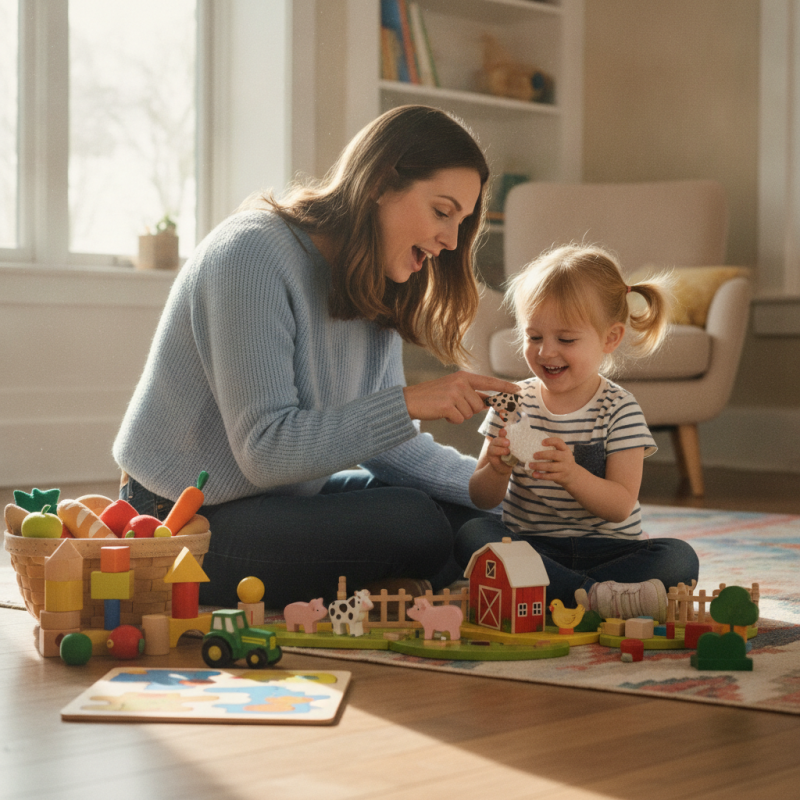
How Do Toys Help With Language Development?
Early childhood language development involves more than learning new words. Children build receptive language, expressive language, speech sounds, turn-taking, and social communication. They learn by hearing language, using gestures, asking questions, and responding to others. The Centers for Disease Control and Prevention’s 2022 milestones indicate that most two-year-olds use at least two words together. By age three, most children can participate in short back-and-forth conversations. These milestones are guides, not exams. Development varies.
Toys can create practical reasons to communicate. A wooden animal set invites words such as “feed,” “sleep,” and “under.” Building blocks encourage requests, descriptions, and problem-solving language. During pretend cooking, an adult might say, “The cup is empty,” then wait for the child’s response. That pause matters. The toy offers the setting, but responsive interaction supplies much of the language learning. UNICEF’s Early Moments Matter report estimates that 43% of children under five in low- and middle-income countries may risk missing developmental potential because of poverty and related factors. Access to toys alone cannot solve this gap.
The common mistake is treating a talking toy as a substitute for conversation. Children need real listeners. Adults can follow the child’s attention, repeat useful words, and gently expand short phrases. “More juice” can become “You want more apple juice.” Small moments count. I also notice that too many toys can reduce focus; one simple object may produce richer dialogue than a crowded playroom. A quiet pause can feel awkward, yet it gives children space to speak.
Play gives children repeated opportunities to listen, imitate sounds, learn new words, take turns, follow directions, and combine words. The chart shows common developmental milestone ages for language skills that can be practiced through activities such as pretend play, picture books, puzzles, and turn-taking games. These are typical ranges rather than strict requirements, because children develop at different rates.
Milestone reference: commonly recognized early-childhood communication milestones from public pediatric and speech-language development guidance. Toys can support practice, but they do not replace responsive interaction with caregivers.
Toys can turn vocabulary practice into an active, memorable experience. A toy kitchen, for example, introduces words such as “spoon,” “pour,” “hot,” and “empty.” Children hear each word while touching, moving, and using related objects. This connection can make new vocabulary easier to understand and remember. Small moments matter. When an adult says, “The blue cup is under the table,” the child hears color, object, action, and location language together.
Pretend play also supports word recognition. Picture cards, blocks, and simple matching games let children see a word repeatedly. An adult might point to a card and say, “This says apple,” then place a toy apple beside it. Repetition should feel natural, not like a test. Language specialists often recommend expanding a child’s words instead of correcting every mistake. If a child says, “Dog run,” an adult can respond, “Yes, the brown dog is running fast.” That response adds detail without interrupting play.
I used to assume that more complex toys created better learning opportunities. I now think the adult’s interaction matters more. A basic box can inspire words like “inside,” “open,” “heavy,” and “again.” Still, not every toy encourages rich conversation. Some toys speak too much, leaving little space for the child’s voice. Quiet play can feel slower. It may also reveal which words the child truly recognizes and which ones require more practice.
| Developmental Stage | Toy Category | Language Opportunity | Vocabulary and Word-Recognition Focus | Adult Interaction Strategy | Observable Learning Behaviors |
|---|---|---|---|---|---|
| Birth–12 months | Cause-and-effect toys, soft books, rattles, textured objects | Joint attention, listening, turn-taking sounds, and early imitation | Names for familiar people, objects, actions, colors, sounds, and textures | Follow the child’s attention, label the object or action, pause for vocal responses, and imitate the child’s sounds | Looks toward a named object, responds to familiar voices, babbles, imitates sounds, or participates in vocal turn-taking |
| 12–24 months | Pretend-play sets, nesting toys, simple puzzles, picture books | Object naming, requesting, following simple directions, and combining words | Everyday nouns, action words, simple descriptors, and basic social words | Use short, clear phrases such as “feed the doll,” expand the child’s words, and offer choices | Points to named pictures, identifies familiar objects, uses gestures or words to request, and attempts two-word combinations |
| 2–3 years | Farm or community play sets, matching games, construction toys, story props | Pretend narratives, categorizing, describing, and answering simple questions | Categories, plurals, locations, size words, verbs, and simple question words | Model complete but brief sentences, ask “what” and “where” questions, and repeat new words in meaningful play | Labels groups of objects, follows two-step directions, describes actions, and produces short sentences during play |
| 3–4 years | Board games with simple rules, dress-up materials, sequencing cards, memory games | Conversation, sequencing events, rule-following, and descriptive language | Emotion words, time-order terms, attributes, positional words, and story vocabulary | Encourage the child to explain choices, retell what happened first and next, and take conversational turns | Retells parts of a familiar story, uses longer sentences, describes objects, and maintains a brief exchange |
| 4–5 years | Alphabet manipulatives, rhyming games, picture-word cards, magnetic letters, puppets | Sound awareness, storytelling, print awareness, and early word analysis | Letter names, beginning sounds, rhyming words, common environmental print, and story terms | Connect spoken words to pictures and letters, play with rhymes, and invite the child to predict or complete sentences | Recognizes some letters or familiar words, notices rhymes, identifies some beginning sounds, and tells a connected story |
| 5–6 years | Word-building games, story sequencing kits, labeled puzzles, simple reading games | Phonological awareness, vocabulary precision, sentence building, and emergent reading | Syllables, initial and final sounds, synonyms, describing words, and high-frequency words | Ask the child to segment or blend sounds, define new words in context, and create sentences with target words | Manipulates sounds in words, recognizes some familiar printed words, explains ideas, and produces more detailed narratives |
Pretend play turns ordinary toys into conversation partners. A cardboard box becomes a shop, a spoon becomes a microphone, and a stuffed animal needs help. Children must name objects, explain actions, and respond to another person’s ideas. These small exchanges build vocabulary and conversational timing.
“Your turn now.” “The bear is hungry.” Simple lines matter.
The American Academy of Pediatrics reported in 2018 that play supports language, self-regulation, and social development. UNICEF and the LEGO Foundation’s Learning through Play report also identifies communication and storytelling as key outcomes of meaningful play. During pretend scenes, adults can add gentle prompts:
“What happened next?” or “Why is the rabbit hiding?”
These questions invite longer answers without turning play into a test. Keep the child in charge.
Research does not prove that every toy improves language. That assumption needs care. The interaction matters more than the object’s price or complexity. A 2020 review in Early Childhood Research Quarterly found that guided play can support learning while preserving children’s agency.
In practice, sit close, follow the child’s storyline, and model one new phrase at a time. Pause often. Let the child struggle with a missing word. That silence can become storytelling space.
If the story changes suddenly, accept it. Real conversations are rarely perfectly organized.
Interactive toys can turn listening into a small, active conversation. A child presses a button, hears a sound, and waits for a response. This pause gives the child time to notice meaning, copy a word, or point toward an object. Toys with simple sounds, matching games, and clear instructions can support vocabulary and basic understanding. The best results often appear when an adult joins the play. Say, “The cow says moo,” then wait. Avoid answering too quickly.
UNICEF data on early childhood development reports that about four in ten children aged two to four do not receive enough cognitively stimulating activities at home. A responsive toy cannot replace a caregiver, but it can create useful moments for shared attention. Research published in JAMA Pediatrics found that electronic toys produced less parent-child language than books and traditional toys. That finding deserves attention. More sounds do not always mean more learning.
Choose toys that invite turn-taking, rather than toys that perform endlessly. Ask, “Where is the red ball?” Pause for several seconds. If the child struggles, offer one clear clue. Real play is often messy. A child may ignore the intended button and focus on the box. That is not failure; it shows curiosity. Still, adults should watch for overstimulation, unclear speech, and repetitive prompts. Calm interaction matters more than flashing lights.
Adults choose the language environment, not just the toy. The American Academy of Pediatrics’ 2019 clinical report recommends simple toys that encourage shared play, conversation, and imagination. A wooden animal, for example, can become a cow, a sound, a story, or a question. Choose toys with several possible actions, such as building, sorting, pretending, and solving. Avoid relying on flashing lights or recorded words. They may entertain children, but they often reduce the adult’s speaking role.
Match the toy to the child’s current communication level. ASHA’s communication milestones for 19–24 months include using and understanding many words, including two-word combinations. Adults can model short phrases: “Red car,” “Car goes,” or “Where is the car?” Pause afterward.
Let the child point, gesture, or answer slowly. This small silence matters. The CDC’s developmental guidance also encourages watching how children use words and combining them during everyday play.
A practical choice should be safe, washable, durable, and easy to share. It should also invite repetition. Read the same picture book beside a toy kitchen, then let the child lead.
Sometimes adults talk too much. I have noticed that children often produce better language when I describe less and listen more.
Keep notes for a week: Which toy creates new words? Which one only creates noise? Reconsider the shelf based on those observations.
It introduces words like “spoon,” “pour,” “hot,” and “empty.” A child hears them while touching and moving objects. Small actions help words feel real.
Describe objects during play, such as, “The blue cup is under the table.” This combines color, object, and location language. Keep it natural.
Yes. Picture cards, blocks, and matching games show words repeatedly. Pair a written word with a real object. For example, match “apple” with a toy apple.
Expand the child’s sentence instead of correcting every mistake. If the child says, “Dog run,” respond, “The brown dog is running fast.” This adds detail gently.
Not always. A simple box can teach “inside,” “open,” “heavy,” and “again.” Adult interaction often matters more than toy complexity. I once underestimated simple toys.
A child presses a button, hears a sound, and waits for a response. That pause supports listening, copying, pointing, and understanding. Wait several seconds.
No. Sound-heavy toys may leave less space for the child’s voice. Books and traditional toys can encourage richer adult-child language. More noise is not more learning.
Choose toys that invite turn-taking and simple answers. Ask, “Where is the red ball?” Offer one clear clue if needed. Do not answer too quickly.
Follow the child’s interest when possible. A child may explore the box instead of pressing buttons. That can show curiosity, not failure. Play can be messy.
Watch for unclear speech, repeated prompts, or restless behavior. Reduce flashing lights and unnecessary sounds. Calm interaction matters more.
Early childhood language development includes learning new words, recognizing their meanings, listening carefully, understanding instructions, and expressing thoughts in clear sentences. How do toys help with language development? Toys create enjoyable opportunities for children to hear, repeat, and use language in meaningful situations. Picture cards, puzzles, and sorting games can introduce vocabulary and strengthen word recognition, while toys with sounds, actions, or simple instructions encourage children to listen and respond.
Pretend-play toys also help children practice conversations, describe roles, and create stories with beginnings, problems, and endings. Through play, children learn to ask questions, take turns, explain ideas, and connect words with experiences. Adults can support language learning by choosing age-appropriate, open-ended toys that invite discussion rather than passive watching. Asking questions, naming objects, expanding children’s sentences, and joining their play can make each activity a valuable opportunity for communication and understanding.
OS Toys